Similar Posts
Attachment Night Vision: Seeing Beneath the Surface in Psychotherapy
Therapists don’t just listen to stories—they read bodies. This article explores how attachment theory and somatic awareness can give clinicians “night vision” to detect what’s unspoken: the nervous system responses shaped by trauma and care. Learn to work with the body as a storyteller in relational healing
This Is Not Just a Request for Attention. This Is a Protest Against Disconnection: A Therapeutic Reframe from David Wallin
What if “attention-seeking” is actually a protest against disconnection? Explore David Wallin’s powerful reframe of client behavior through the lens of attachment theory—and how it can transform your therapeutic presence
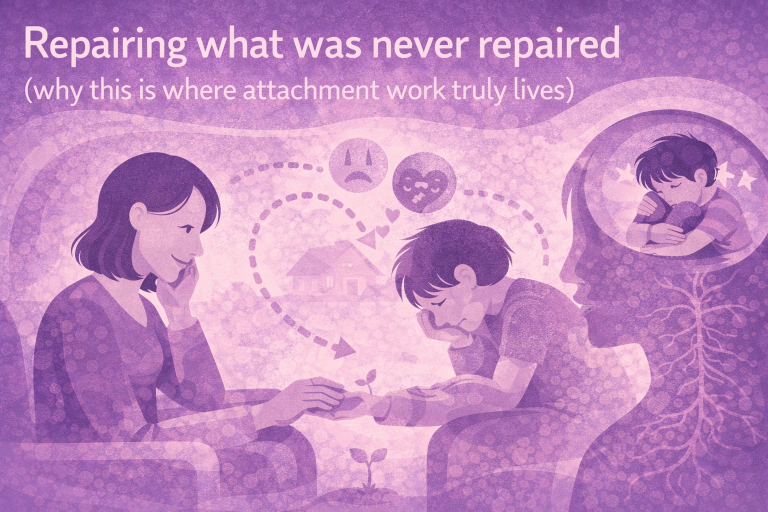
Repairing What Was Never Repaired
(Why This Is Where Attachment Work Truly Lives) There’s a common misconception in therapy that change happens in moments of insight. A realisation lands.A pattern makes sense.A link to childhood becomes clear. These moments matter – but in attachment-informed work, they’re rarely where the deepest healing occurs. That happens somewhere else entirely. It happens in…
Disorganised Attachment: When the Person Who Should Protect You Also Frightens You
Disorganised Attachment: When the Person Who Should Protect You Also Frightens You Disorganised attachment is one of those areas of attachment theory that I find both fascinating and, if I’m honest, quite difficult to get my head around at times. Not because the basic idea is particularly complicated. In fact, when you strip it back,…
Myth: Attachment-based therapy is too abstract to apply to real-world problems. The truth: Neuroscience helps therapists turn attachment concepts
Attachment-Based Therapy Isn’t “Too Abstract”—Here’s How Neuroscience Makes It Practical If you’ve ever dismissed attachment-based therapy as too abstract or “theoretical,” you’re not alone. It’s easy to feel that way when terms like secure attachment, internal working models, or attachment styles are thrown around in ways that sound more academic than actionable. But here’s the…
Why Understanding a Client’s Internal World Can Reduce Therapist Panic
I’ve been thinking about when I feel panic in the therapy room. Not full-blown panic, necessarily. More that quiet, internal scrambling that can creep up when the work starts to feel complex. Suddenly, I can feel myself trying to find the right thing to say, make the right intervention, ask the right question, or produce…