Disorganised Attachment: When the Person Who Should Protect You Also Frightens You
Disorganised attachment is one of those areas of attachment theory that I find both fascinating and, if I’m honest, quite difficult to get my head around at times.
Not because the basic idea is particularly complicated. In fact, when you strip it back, the starting point is fairly simple. A child naturally looks to their caregiver for safety, comfort and protection. But what happens when that same caregiver is also frightening, unpredictable or simply unable to offer that safety?
Where does the child go then?
That was the question at the heart of a recent episode of Attach Together, where Gav McKee a counsellor and attachment-based psychotherapist spoke with our colleague Darren Sharpe about disorganised attachment and what it might mean for us as therapists.
The more they talked, the more I was reminded that this isn’t really a subject we can understand by looking at behaviour alone. We need to think about what sits underneath the behaviour and, importantly, what that behaviour may once have been doing for the person.
So, what actually is disorganised attachment?
Disorganised attachment grew out of the attachment research that followed Mary Ainsworth’s Strange Situation procedure.
Researchers noticed that some children didn’t seem to fit neatly into the attachment patterns that had already been identified. Their behaviour around their caregiver could appear confused or contradictory. A child might move towards their caregiver and then stop, freeze, turn away or seem momentarily disorientated.
Mary Main and Judith Solomon later identified these behaviours as disorganised/disoriented attachment.
One of the ideas Gav talked about in the podcast was “fright without solution”, and I think this gets us quite quickly to the difficulty the child is facing.
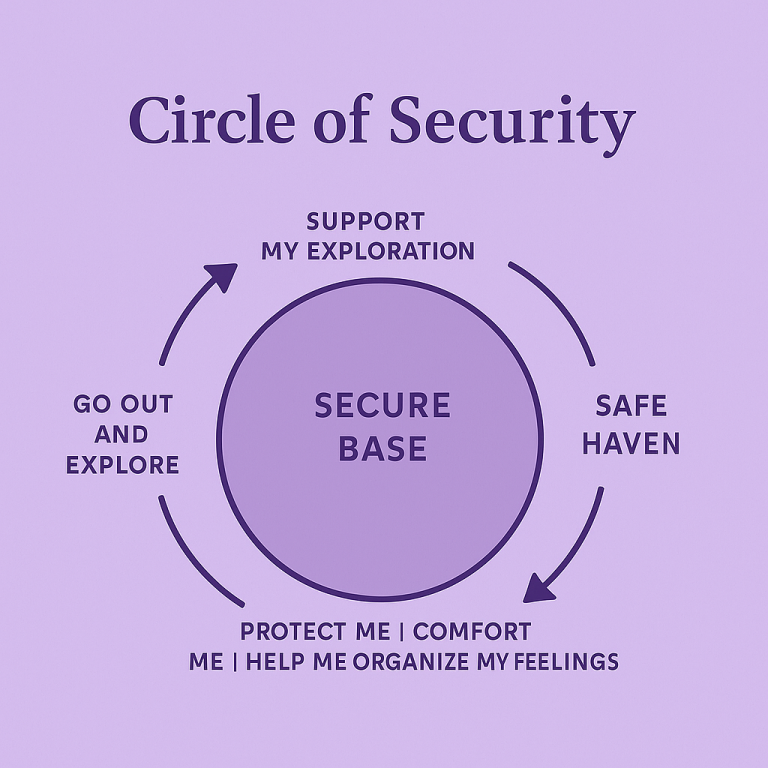
If I’m frightened, I need my caregiver.
But what happens if my caregiver is also the person I’m frightened of?
I want to move towards you because I need you, but something in me also wants to get away from you.
There isn’t an obvious solution to that.
And when you imagine this from the child’s perspective rather than simply reading it as attachment theory, I think you begin to appreciate just how difficult that experience might be.
It isn’t always as simple as an abusive parent
This is something I think we need to be careful about.
When we talk about a caregiver being frightening, it’s very easy to jump straight to abuse. Of course, frightening or aggressive behaviour can be part of the picture, but that isn’t the whole story.
Gav talked about three possibilities in their conversation: a caregiver can be frightening, they can themselves be frightened, or they can become psychologically unavailable through something like dissociation.
That second one really interested me.
Imagine being a very young child and becoming distressed, only to see that your distress seems to frighten the adult you depend on. The person who is supposed to know what to do suddenly looks as frightened as you feel.
What does a child make of that?
Then there is the caregiver who has their own unresolved trauma or loss. Something about their child’s distress might activate something in them that they don’t fully understand themselves.
This is where disorganised attachment becomes much bigger for me.
Because we can start with the child, but very quickly we’re looking at the parent’s experiences, and perhaps their parent’s experiences too. There can be a whole history sitting behind what is happening between one caregiver and one child.
Understanding that isn’t the same as excusing harmful parenting.
We can have compassion for what a parent may have experienced and still be honest about the impact their behaviour had on their child. I think we have to be able to hold both.
What happens as that child gets older?
Children adapt.
That’s something attachment theory comes back to again and again.
What looks confusing or difficult from the outside often makes much more sense when we understand what the child has had to adapt to.
Gav explained that as some children with these early experiences get older, they can begin to find ways of taking more control of the relationship.
For one child, that might mean becoming very caregiving towards their parent. They become the one monitoring how Mum or Dad is feeling, trying to keep everything calm and taking on far more emotional responsibility than a child should really have.
For another child, control might look more dominant, critical or punitive.
I found myself thinking about this quite a lot about this.
If the adults around you are safe and predictable, you don’t really need to control them. You can get on with being a child.
But if the relationship is unpredictable, taking some control of it might make complete sense.
There is almost an underlying logic of: if I can control what’s happening between us, perhaps I can stop you frightening me.
That doesn’t mean the strategy won’t cause difficulties later. But it does help us understand why it might have developed in the first place.
And then the client arrives in our therapy room
This is where attachment theory becomes particularly useful for me.
We’re not usually sitting opposite an adult client who tells us, “I have disorganised attachment and this is how it affects me.”
We see the relationship difficulties.
We see someone who desperately wants closeness but becomes frightened when they get it.
We might see intense emotions followed by numbness, or someone who seems to disappear from the room through dissociation.
There can be deep shame. A feeling that there is something fundamentally wrong with them. Relationships can feel incredibly important and incredibly dangerous at the same time.
We also need to be careful with our language here. Disorganised attachment isn’t a diagnosis, and we shouldn’t start diagnosing someone’s attachment style because they have complex PTSD, a personality disorder diagnosis or experiences of dissociation.
Attachment gives us a way of thinking about what might be happening. It shouldn’t become another label we put on somebody.
For me, the more useful question is:
What does this person’s behaviour make sense in the context of?
That question tends to take us somewhere much more interesting.
Why would somebody push you away when they want you to stay?
This is one of the parts of disorganised attachment that can initially seem contradictory.
A client may want connection and then retreat from it.
They might begin trusting us and suddenly become distant.
They may worry about being abandoned while also finding closeness almost unbearable.
They might test whether we’re really going to be there.
And, of course, all of this can happen in relationships outside therapy too.
If you only look at the behaviour, it can be frustrating. You can end up thinking, What do you actually want from me?
But put it back into the context of that original attachment dilemma and it starts to look different.
I need you.
I’m frightened of needing you.
I want you close.
I’m not sure it’s safe when you’re close.
Those things can exist together.
The fire analogy
Gav used an analogy in the episode that has really stayed with me.
Imagine a child outside in the cold who needs a fire to keep warm.
They move towards the fire and it warms them. But every now and then, without warning, the fire flares up and burns them.
What do they do?
They still need the warmth.
So perhaps they approach the fire, but never completely relax around it. They move closer, then back away. They keep watching it. They enjoy the warmth but remain ready for the moment it might hurt them again.
I think that gives us a really useful way of understanding some of what we might see in adult relationships and in therapy.
The person isn’t necessarily being “difficult”. Their experience may have taught them that closeness is something they need to monitor.
Then we become part of the attachment relationship
This is the bit that I think we can sometimes underestimate as therapists.
We aren’t standing outside all of this observing it.
We’re in the relationship too.
A client might start to feel close to us and then pull away. They might challenge us, become angry, withdraw or test whether we’re really as reliable as we appear to be.
And that does something to us.
We might feel rejected. We might feel anxious. We might desperately want to reassure the client. We might feel we’re doing something wrong. We may even start trying harder and harder to prove that we’re safe.
I’ve noticed in my own work that some sessions involving unresolved trauma can leave me needing a little time afterwards to ground myself. I don’t necessarily want another client immediately walking through the door.
I think that’s worth paying attention to rather than pretending that, as therapists, we’re somehow unaffected by what happens in the room.
The therapeutic relationship involves two people. If we’re hoping to offer our steadiness to somebody else, we need to think about how we’re maintaining our own.
That’s where supervision becomes incredibly important.
Safety first doesn’t mean we’re avoiding the work
One of Gav’s clearest messages in the episode was: go slowly.
I think that’s worth emphasising because therapy can sometimes create pressure to get somewhere.
We want to reach the trauma. We want to understand what happened. We want the client to make progress.
But what if slowing down is the work?
For somebody whose experience of relationships has involved unpredictability, simply having a therapist who is consistent, boundaried, warm and reliable may be doing far more than it appears to be doing.
Before we start trying to process trauma, we need enough safety and stability for the person to stay with what they’re experiencing.
That might involve grounding.
It might involve noticing what’s happening in the body.
It might involve helping somebody recognise, I’m being triggered right now, but I’m here, in this room, and this isn’t what happened then.
Sometimes the work can look surprisingly ordinary.
What if a client dissociates in the room?
This is something I remember encountering early in my own practice.
The first time a client dissociated with me, I was scared.
I didn’t feel particularly well equipped. I knew something had changed, but I wasn’t completely sure what I was supposed to do with it.
I spoke to my supervisor afterwards and then went on to do further CPD around dissociation. One of the things I took from that was that we don’t always need an elaborate therapeutic intervention.
First, we need to help the person come back to the present.
Sometimes that can mean talking about what’s happening in the room. Sometimes it’s grounding through the body. And sometimes it might be something as everyday as talking about the song they heard on the way to therapy or what they’re planning to have for dinner.
It can sound almost too simple.
But if somebody has gone somewhere else internally because what they were feeling became too much, the immediate job isn’t necessarily to explore more deeply.
It’s to help them come back.
Then, when it’s appropriate, we can become curious together about what happened.
What came just before it?
What might the dissociation have protected them from?
When has disappearing in this way helped them before?
Again, we’re moving away from How do I stop this? and towards What does this make sense in the context of?
Can things really change?
It’s important that discussions about disorganised attachment don’t leave people feeling that their early experiences have determined the rest of their lives.
They haven’t.
Change is possible.
That doesn’t mean pretending the past didn’t happen or trying to remove every trace of it.
Gav compared it to a physical wound.
A wound can heal and leave a scar. The scar tells us something happened, but the area doesn’t have to remain so raw that every touch hurts.
I like that way of thinking about it.
The aim isn’t to erase somebody’s history. It’s to help what happened become more integrated, so it doesn’t have to keep taking over the present.
Over time, someone may become more able to notice what they’re feeling without immediately becoming overwhelmed by it. They might recognise when an old attachment fear has been triggered. They may be able to remain in a relationship when part of them wants to run from it.
And they can have new experiences of relationships.
Including, potentially, the relationship they have with us.
Maybe consistency really is the intervention
When I think back to the fire analogy, I think this is where it becomes most hopeful.
We can’t simply tell somebody who has repeatedly been burned that fires are safe.
Why would they believe us?
They need to experience a different kind of fire.
One that is warm without suddenly flaring up.
One they can move towards at their own pace.
One that doesn’t punish them for moving away.
And perhaps that is part of what attachment-informed therapy can offer.
We turn up.
We try to remain curious.
We hold boundaries.
We notice when something has happened between us and, where possible, we talk about it.
We don’t rush somebody because we think they should be further along.
None of that sounds particularly dramatic, and perhaps that’s the point.
For somebody whose early relationships were unpredictable, predictability can be a very big deal.
Disorganised attachment is a huge subject, and one conversation certainly doesn’t cover all of it. But if there is one thing I’ve taken away from exploring it, it’s that we need to keep looking underneath the behaviour.
Instead of asking why somebody keeps pushing people away, we might wonder what closeness has meant to them before.
Instead of seeing dissociation simply as something to get rid of, we might wonder what it has helped them survive.
Instead of assuming that control is about being difficult, we might ask what it feels like to live without any sense of control at all.
And perhaps, as therapists, we can keep asking ourselves one question:
What would help this person experience this relationship as safe enough to stay in?
Not perfectly safe. Not instantly trusting.
Just safe enough for us to begin.