Let’s Listen
Listen
Attachment Theory Beyond the Parent-Child Relationship
Attachment theory child therapy invites us to look beyond the behaviour of the individual child and become curious about their relationships, family, history and wider environment. When we think about attachment theory and attachment styles in counselling and therapy, what changes when our focus moves from “What is happening with this child?” towards “What is happening around this child, and within the relationships and systems they inhabit?”
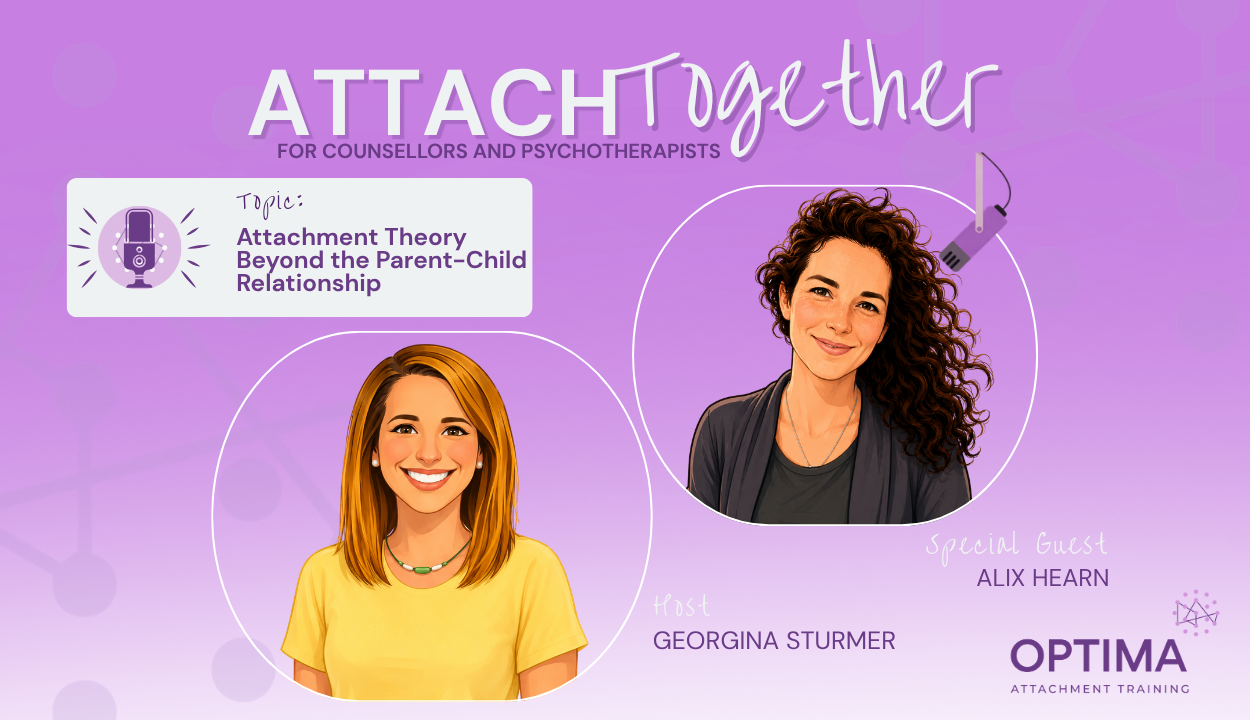
In this episode of Attach Together, attachment-based psychotherapist Georgina Sturmer is joined by child and adolescent psychotherapist Alix Hearn for a wide-ranging conversation about attachment, systems, play, place, intergenerational experience and therapeutic relationships.
What is a systemic approach to attachment?
A systemic approach to attachment considers attachment patterns within the network of relationships, environments, histories and wider systems that shape a person’s experience, rather than locating the difficulty solely within the individual.
Alix questions what can happen when children’s behaviour becomes the primary focus of therapeutic intervention. Children do not develop in isolation. Their experiences may be shaped by parents and carers, education, social care, culture, faith, developmental change, previous trauma and the wider environment.
The conversation also explores attachment theory child therapy through Bronfenbrenner’s ecological thinking and the importance of recognising the many “circles” surrounding a child.
In this episode
Georgina and Alix explore:
- Why attachment needs to be understood relationally and systemically
- The limitations of focusing solely on a child’s behaviour
- Intergenerational attachment patterns and trauma
- Building therapeutic alliances with parents and carers
- Why play is a language of relationship in child therapy
- Attachment, belonging and the “more-than-human world”
- Place attachment and our relationships with physical environments
- Children’s agency and whether a young person actually wants therapy
- How systems can inadvertently recreate relational or attachment difficulties
- The ethical questions raised by very short-term therapeutic work
Alix also raises an important challenge for practitioners: when a child has experienced repeated loss, disruption or relational trauma, is offering six sessions necessarily better than offering no therapy at that point? Or might another intervention within the child’s wider system sometimes be more appropriate?
There are no simple answers, and the discussion deliberately leaves room for clinical thinking rather than offering a universal rule.
Common questions
What is attachment theory in child therapy?
Attachment theory in child therapy offers a way of understanding how experiences of safety, connection, separation and relationships may shape a child’s ways of relating to themselves and others.
How do attachment styles affect relationships?
Attachment patterns can influence expectations of closeness, safety, care and connection. Alix encourages practitioners to remain curious about these patterns without reducing children or adults to fixed categories.
Why should therapists consider the wider system?
A child’s difficulties may make more sense when considered alongside family relationships, intergenerational experiences, education, culture, professional systems and environment.
What role does play have in attachment-informed therapy?
For younger children in particular, play can be a primary language through which relationship, emotion, exploration and experience are communicated.
About Alix Hearn
Alix Hearn is a child and adolescent psychotherapist with more than 14 years’ experience working with children, young people and families across different settings. Her work draws together attachment theory, child development, systemic thinking and environmental perspectives.
She is also the author of Places of Safety: How Attachment Shapes Our Parenting.
YouTube chapters
00:00 Welcome to Attach Together
01:40 Rethinking attachment through systems and environment
02:47 Moving beyond a focus on the child’s behaviour
04:22 Intergenerational attachment and family formulation
05:46 The circles and systems surrounding a child
07:31 Why children become the focus of therapeutic intervention
09:34 Building trust with parents and carers
11:19 Working therapeutically with families
12:32 Play as the language of child therapy
14:59 Decolonising therapeutic thinking and systemic harm
17:25 Children’s agency and choice in therapy
19:16 Place attachment and the more-than-human world
23:37 Ethical dilemma: is short-term therapy always helpful?
26:18 Alix’s work and book
26:34 CPD certificate and closing
Resources mentioned
Alix Hearn: alixhearn.co.uk
Book: Places of Safety: How Attachment Shapes Our Parenting
Optima: OptimaAttachment.co.uk
CPD certificate: Available via the Optima website and episode show notes.
If this episode prompts you to think differently about attachment theory child therapy, take some time after listening to consider not only the client in front of you, but the relationships, places and systems surrounding them.
Listeners can also access the accompanying CPD certificate to record their professional learning.