
Let’s Listen
Listen
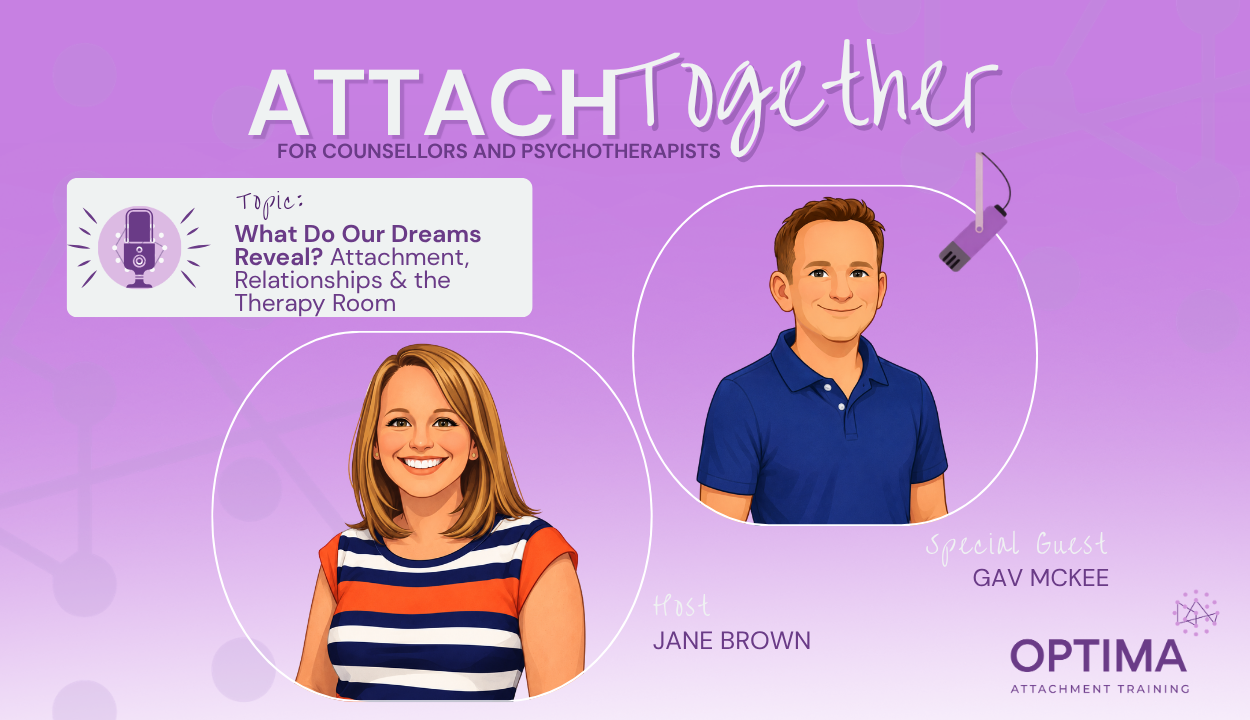
What Do Our Dreams Reveal? Attachment, Relationships & the Therapy Room
Exploring Dreams Through Attachment Theory and Attachment-Informed Therapy
Attachment dreams in therapy can give us another way of thinking about attachment theory, attachment styles, relationships and what may be happening beneath the client’s conscious story.
In this episode of The Attachment in Practice Podcast, Jane is joined by Gav McKee, an Internal Family Systems (IFS) trained psychotherapist and tutor on the Level 5 Diploma, for a conversation about dreams — and why therapists might want to pay more attention to them.
Gav describes dreams as another window into a client’s inner world. They don’t necessarily tell us what happened, or give us something that needs to be decoded. What they can sometimes show us is how relationships feel to that person.
Who is there when they are frightened? What happens when they need someone? Is vulnerability met with care, distance, rejection or something less predictable?
These are attachment questions.
Dreams through an attachment lens
Attachment dreams in therapy are dreams explored for what they may reveal about a person’s expectations of safety, closeness, vulnerability and other people.
The conversation moves through some of the ways different attachment patterns may show up in dreams.
With anxious or preoccupied attachment, there may be themes of abandonment, separation, infidelity or searching desperately for someone.
With avoidant or dismissing attachment, the picture can look quite different. A person may remember fewer dreams, or their dreams may contain more distance, independence and difficulty connecting.
Disorganised attachment can bring more contradictory material: wanting to move towards someone while also being frightened of them.
None of this gives us a formula for reading dreams. Gav is careful about that throughout the conversation. These are cues we can become curious about, rather than evidence from which we draw firm conclusions about a client’s attachment style.
Working with dreams in the therapy room
One of the most useful parts of the discussion is the shift away from interpreting a dream for the client.
Instead, Gav talks about asking a client to retell a dream in the present tense and noticing what changes as they do. Which part draws their attention? What are they feeling? What happens when they need help?
Drawing on his IFS training, he also explores how different people, creatures or objects within a dream can sometimes be approached as parts. A frightening figure, for example, may look very different when the client experiments with seeing the dream from its perspective.
There is room for creativity here. An unfinished or recurring dream can sometimes be explored by asking what the client would want to happen next.
What if the therapist appears in the dream?
As therapy deepens, the therapist may become an important attachment figure and begin to appear in the client’s internal world.
Sometimes the dream therapist rescues. Sometimes they criticise, forget, abandon or care for the client. At other times, they may simply accompany them.
Rather than deciding what this means, we can become interested in what is happening relationally. What did the client expect from the therapist in the dream? What did it feel like when they responded — or didn’t?
Even choosing to tell a therapist about a dream may say something about the trust developing between them.
Can dreams change as attachment changes?
Perhaps.
Gav talks about noticing subtle shifts over the course of therapy. A client who previously faced everything alone may ask for help in a dream. Someone might come when they are distressed. A frightening figure becomes less frightening, or a vulnerable child is protected rather than left alone.
We shouldn’t use dreams as proof that earned secure attachment has developed.
They may, though, give us another glimpse of an internal working model beginning to change.
When a dream is too much
The episode closes with an important clinical dilemma.
What if a client has a recurring, frightening dream and becomes visibly overwhelmed when they begin talking about it?
However interesting the material might be, this isn’t the moment to push further.
If the client is outside their window of tolerance, the immediate task is to help them find enough safety and regulation to remain present. The therapist’s role as a secure base matters more than getting to the meaning of the dream.
As Gav puts it through a helpful analogy: there’s little point trying to read the map while you’re still caught in the storm.
In this episode
01:28 — Why dreams matter in therapy
04:15 — Why do we dream? Freud, Jung and neuroscience
07:16 — Dreams through attachment theory
09:23 — How attachment styles may appear in dreams
12:52 — Working creatively with dreams in therapy
17:44 — What does it mean when a client dreams about their therapist?
20:20 — Dreams and earned secure attachment
23:31 — Why curiosity matters more than interpretation
26:15 — Clinical dilemma: recurring and frightening dreams
28:50 — Regulation, pacing and being a secure base
Questions therapists often ask
How do dreams relate to attachment theory?
Dreams may give us clues about a person’s internal working models — particularly what they expect to happen when they need closeness, comfort or protection.
Can you identify someone’s attachment style from their dreams?
Dream themes may offer useful cues, but they shouldn’t be treated as a way of diagnosing attachment style. They give us something to explore alongside the wider therapeutic picture.
Should therapists interpret clients’ dreams?
In this attachment-informed approach, the emphasis is less on providing an interpretation and more on helping the client explore their own emotional and relational experience of the dream.
What if talking about a dream overwhelms the client?
Slow down. If the client is becoming dysregulated, safety comes first. Exploration can happen when there is enough regulation for the client to stay with what emerges.
Continue your reflection
A CPD Reflection Pack accompanies this episode, with questions for personal reflection and supervision alongside practical ideas for bringing dream work into attachment-informed practice. Get your CPD certificate here