
Let’s Listen
Listen
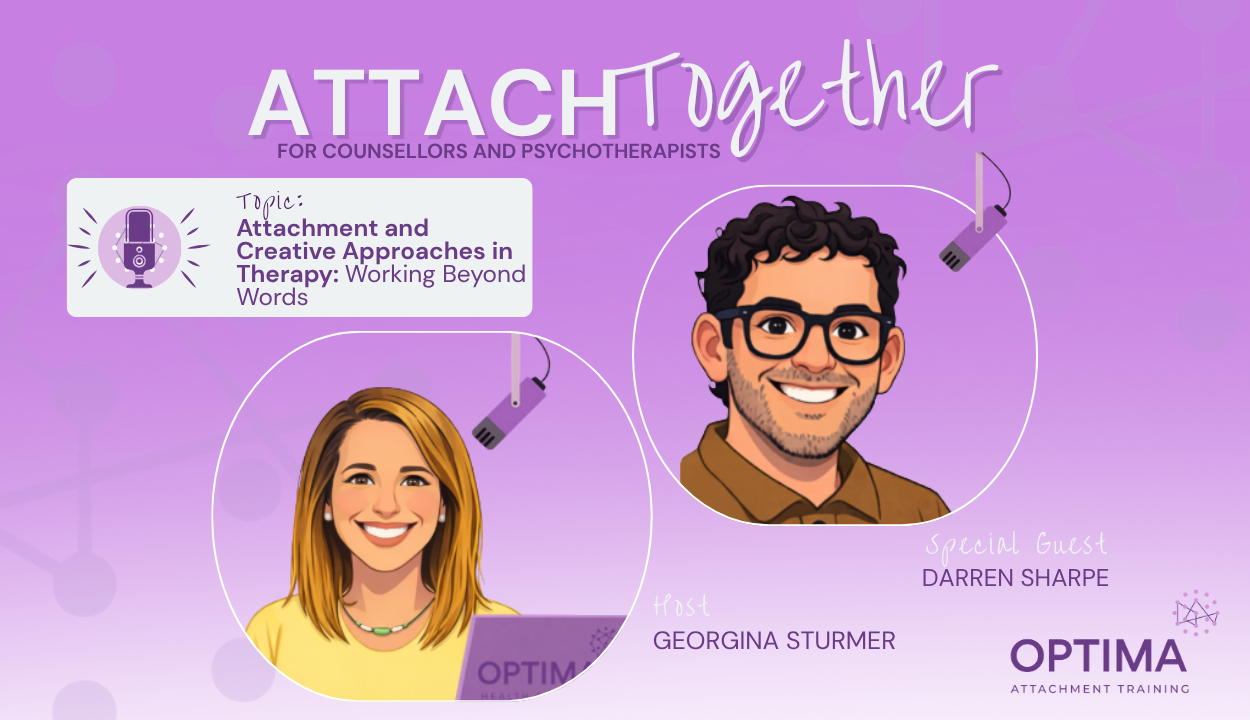
Attachment and Creative Approaches in Therapy: Working Beyond Words
Attachment and Creative Approaches in Therapy: Working Beyond Words
Attachment Theory, Therapy & Relationships
Creative approaches in therapy can help clients explore emotional experiences that are difficult to access through words alone. Through the lens of attachment theory, attachment styles, relationships and therapy, Georgina Sturmer and Darren explore what happens when therapists introduce metaphor, imagery, play and objects into the counselling room.
Creative work does not necessarily mean asking a client to paint or draw. In attachment-informed therapy, creativity might involve visual cards, stones, buttons, sand tray work, nesting dolls, games or a shared metaphor that gives language to a client’s internal world.
Creative approaches in therapy are therapeutic ways of using imagery, metaphor, play, sensory experience or physical objects to support emotional exploration and communication.
For clients who find direct emotional language difficult, these approaches can create another route into the work.
Darren and Georgina consider how creativity can support clients who feel stuck, mistrust their own version of events or experience shame around getting therapy “right”.
In this episode, we explore:
- Why creative therapy is about more than pens, paper and paint
- How play can support relational connection and the therapeutic alliance
- Creativity, the inner child and pre-verbal emotional experience
- Using Uno and games to soften the intensity of conversation
- Stones and objects as representations of a client’s relational world
- How visual work can provide a snapshot of therapeutic change
- Sensory and somatic aspects of sand tray work
- How avoidant attachment behaviours may influence responses to creativity
- Shame, perfectionism and the fear of doing creative work incorrectly
- Drawing with the non-dominant hand
- Why therapists should notice rather than interpret a client’s imagery
- Nesting dolls as a metaphor for attachment-based psychotherapy
- Creative approaches in online therapy
- Using swimming pool imagery to explore the therapeutic relationship
- Castles, gates, bridges and islands as metaphors for defensive strategies
- How creativity can be explored in supervision
- The importance of therapist self-awareness and pacing
- Creativity, Attachment Styles and the Therapy Relationship
A client’s response to creative work may itself offer useful relational information.
Some clients may quickly engage with play, images or metaphor. Others may experience uncertainty, embarrassment or shame.
For clients with more avoidant attachment tendencies, a creative invitation can initially feel exposing or unfamiliar. Yet removing the pressure to tell a coherent story may also create new possibilities for emotional contact.
The therapeutic task is not to force creativity.
It is to remain curious about what happens when it is offered.
What Does Creative Work Reveal?
The finished drawing, sand tray or arrangement of stones is only one part of the process.
Therapists can also remain curious about:
Whether the client becomes quiet
How quickly or slowly they work
Whether they appear excited or hesitant
The presence of shame or self-criticism
Changes in the client’s body or energy
How the client experiences the therapist while creating
The meaning of creative work belongs to the client.
Rather than diagnosing or imposing an interpretation, an attachment-informed therapist might gently notice:
“I notice there’s a lock on the door.”
Or:
“I noticed you became quieter as you drew that.”
The invitation is towards curiosity rather than certainty.
Common Questions
What are creative approaches in therapy?
Creative approaches in therapy use metaphor, images, play, sensory materials or objects to help clients explore emotional and relational experiences that may be difficult to communicate verbally.
How can creativity support attachment-informed therapy?
Creativity can give clients a less direct way to explore attachment trauma, attachment styles and relationships. Visual and metaphorical work may help clients communicate experiences for which they do not yet have words.
Are creative approaches only suitable for children?
No. Play, metaphor and creative exploration can also be valuable when working therapeutically with adults. Adults may carry pre-verbal, sensory and relational experiences that are difficult to reach through cognitive discussion alone.
How should therapists interpret a client’s creative work?
The therapist should avoid imposing a fixed interpretation. The client’s meaning is central. Therapists can notice what they observe and invite the client to explore their own understanding.
Can creative approaches be used in online therapy?
Yes. Therapists can use visual metaphors, objects, drawings and items such as nesting dolls when working online. Creativity does not have to depend on sharing the same physical room.
About the Hosts
Georgina Sturmer is an attachment-based psychotherapist working in private practice. Alongside her clinical work, she trains psychotherapists and teaches on Optima’s Level 5 programmes.
Darren works from an attachment-informed perspective and has a particular interest in creative therapeutic approaches, attachment theory and training psychotherapists.
Together, they explore how attachment theory can move beyond academic understanding and become part of thoughtful, relational clinical practice.
Resources Mentioned
Visual image cards
Stones and buttons
Sand tray work
Uno and therapeutic play
Drawing with the non-dominant hand
The armoire or wardrobe exercise
Nesting dolls
Swimming pool metaphor
Castles, gates, bridges and islands
Stones and feathers lifespan exercise
Clinical supervision
Continue Your Reflection
A CPD certificate is available for the time spent listening to this episode.
Access your CPD certificate and reflection resources: Here
For more conversations about attachment theory, attachment styles, attachment trauma, attachment-informed therapy and relationships, subscribe to Attached Together on YouTube, Spotify or Apple Podcasts.
You might also consider taking one question from this episode into your next supervision session:
When I introduce creativity into therapy, whose needs and enthusiasm are leading the intervention?